
Behind the dream beaches of southern Corsica lies a completely different Corsica: one of granite peaks, laricio pine forests and perched villages clinging to the mountainside. Welcome to the Alta Rocca, the authentic, unspoiled hinterland of the south of the island. Between sea and mountains, this micro-region unfurls its Bavella Needles, its Cuscione plateau and its characterful villages where time seems to have stood still. A land of hiking, heritage and nature in its purest form, the Alta Rocca is the ideal destination for discovering a Corsica far from the crowds. Follow the guide.
The Alta Rocca, the mountain heart of southern Corsica
Set inland, the Alta Rocca occupies the mountainous part of southern Corsica, between the Gulf of Valinco and Sartène to the west, Porto-Vecchio to the east and Solenzara to the north-east. Crossed by the Rizzanese and its tributaries, it rises from maquis-covered hills to high summits, around Monte Incudine (2,134 m), the highest point in the south of the island. A large part of its territory belongs to the Regional Nature Park of Corsica, a guarantee of protected landscapes.
The region’s very name tells its story. The Alta Rocca was the fief of the lords of la Rocca, the powerful feudal families who dominated southern Corsica in the Middle Ages. The area is still readily nicknamed the “land of the lords”. From this history remain proud, independent villages, Romanesque chapels and a rich built heritage. Here, altitude also brings welcome freshness: when the coast swelters in high summer, the Alta Rocca offers crisp air, clear rivers and shady forests.
The perched villages of the Alta Rocca
The charm of the Alta Rocca lies first of all in its perched villages, set on rocky spurs facing the mountains. Each has its own character, its church and its stone lanes.
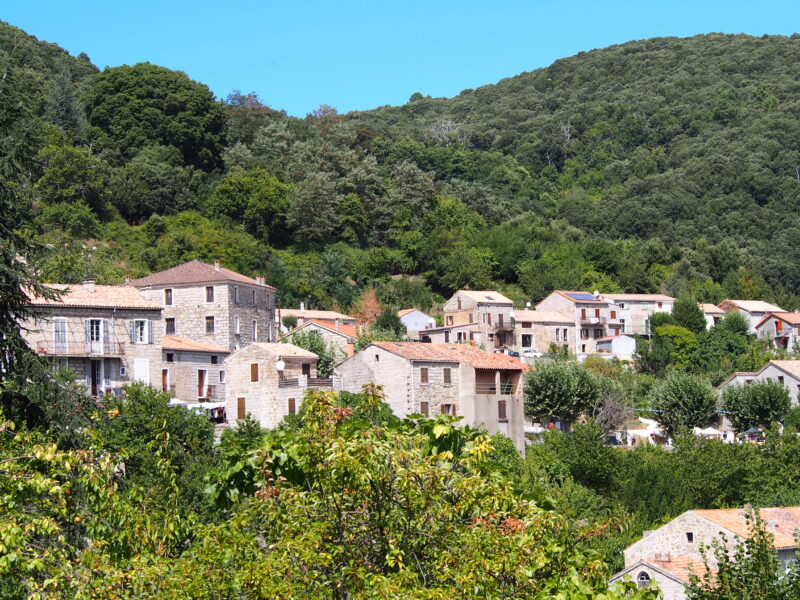
Levie, the capital of the Alta Rocca
The true heart of the region, Levie (Livia) is the ideal starting point for exploring the Alta Rocca. The village is home to the Alta Rocca Museum, which traces local prehistory and history and notably preserves the “Lady of Bonifacio”, one of the oldest human skeletons discovered in Corsica. A few kilometres away, the archaeological site of Cucuruzzu and Capula plunges visitors into the Bronze Age, along a shaded path among the granite chaos and holm oaks.
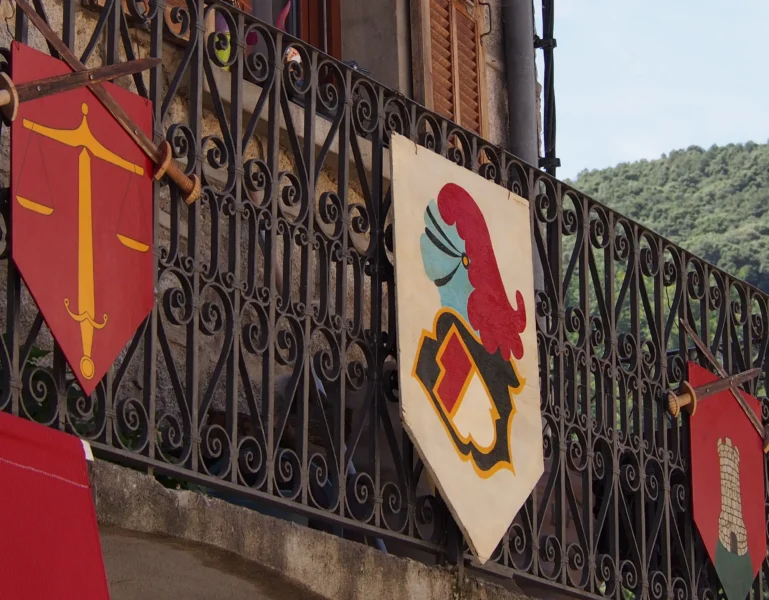
Every year since 2011, Levie travels back in time with the Médiévales de Levie, a not-to-be-missed event in early September. The village dons period costumes to bring medieval Corsica back to life: parades, a craft market, encampments, shows and activities immerse young and old in the atmosphere of the Middle Ages, among the stone lanes. A perfect event for discovering Levie differently, at the very end of the summer season.
Zonza, the gateway to Bavella
Perched at more than 750 metres above sea level, Zonza is the crossroads village of the Alta Rocca: it is from here that the road climbs towards the famous Bavella pass. Surrounded by laricio pine forests, Zonza charms visitors with its mountain atmosphere and its strategic position for heading out to the Bavella Needles as well as the beaches of the south.
Quenza, between heritage and high mountains
Neighbouring Zonza, Quenza is the gateway to the Cuscione plateau. The village preserves a fine religious heritage, including the Santa Maria chapel and ancient frescoes. It is also a popular starting point for high-altitude hikes and outdoor activities, on foot or on horseback.
Sainte-Lucie-de-Tallano, the village of the olive tree
Above the Rizzanese valley, Sainte-Lucie-de-Tallano is renowned for its olive oil and its terraced olive groves. The village is worth a stroll for its Saint-François convent, its fountains and the local marble, the famous “orbicular diorite”. A must-visit for a taste of the Alta Rocca’s way of life.
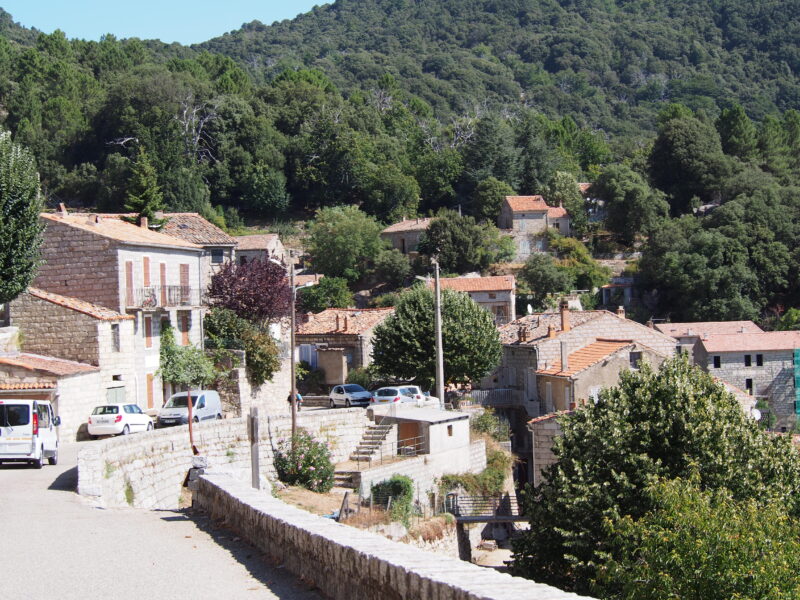
And also: Aullène, Serra-di-Scopamène, Carbini…
The Alta Rocca has many other gems: Aullène and Serra-di-Scopamène, up on the heights, with their orii (shelters under the rock); Carbini and its Romanesque church San Giovanni Battista, cradle of the history of the Giovannali. So many villages in which to soak up Corsican authenticity.
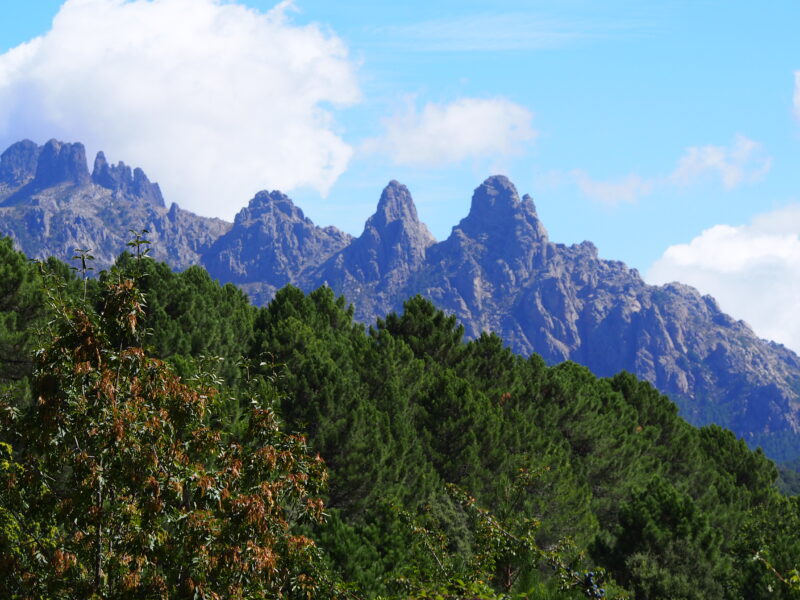
Bavella and the great outdoors
It is impossible to mention the Alta Rocca without its Bavella Needles, emblem of southern Corsica. These towers of red granite rising into the sky form one of the most spectacular landscapes on the island. The Bavella pass (1,218 m), reached by a winding mountain road, offers a breathtaking panorama of the Bavella massif and its forests. It is the starting point for legendary hikes, including the famous Trou de la Bombe (U Cumpuleddu), a natural arch pierced through the rock, and the alpine variant of the GR20.
To plan your visit, its trails and its viewpoints, see our guide: The Bavella Needles, at the heart of the Alta Rocca.
Further to the south-west stretches the Cuscione plateau, a vast high-altitude pasture dotted with pozzines (peaty lawns) at the foot of Monte Incudine. This unique landscape, where herds graze in summer pasture, is discovered on foot or on horseback in absolute silence. All around, the immense laricio pine forests — at Bavella as on the Ospedale road — are a reminder that the Alta Rocca is above all a forest kingdom.
Hiking and outdoor activities
The Alta Rocca is a paradise for hiking enthusiasts. Long-distance trails reign supreme here: the GR20 crosses the Bavella massif in its southern section, while the Mare a Mare Sud crosses the region from east to west, linking the villages of Levie and Quenza. For a day out, the Trou de la Bombe and the hiking circuits around Bavella are suitable for the whole family.
Water is the territory’s other great asset. In summer, the rivers offer superb natural pools for swimming, particularly along the Rizzanese. Thrill-seekers take to canyoning in the famous Bavella canyons (Purcaraccia, Vacca, Pulischellu), with their natural basins and slides. Add to this horse riding on the Cuscione plateau, mountain biking and climbing on the needles. Before setting off, a stop at the Alta Rocca tourist office helps you choose the route suited to your level.
Heritage and archaeological sites
The Alta Rocca is also a land of age-old history. The site of Cucuruzzu and Capula, near Levie, bears witness to occupation from the Bronze Age, with its casteddu (fortified settlement) nestled in a granite chaos. The Alta Rocca Museum, in Levie, is the ideal complement to the visit, tracing thousands of years of human history in the region. Don’t miss the Romanesque chapels and churches scattered among the villages either, nor the pastoral heritage of the high-altitude sheepfolds. A concentrate of Corsican history in the open air.
When to go and how to reach the Alta Rocca
The Alta Rocca can be visited all year round, but each season has its charm. Summer draws those escaping the coastal heat, with its river swimming and cool hikes. Autumn reveals the chestnut forests and blazing colours, while spring offers nature in bloom and deserted trails.
As for access, several mountain roads lead to the Alta Rocca: from Porto-Vecchio via the Ospedale forest and Zonza; from Propriano and Sartène via Sainte-Lucie-de-Tallano; and from Solenzara via the spectacular Bavella pass. The airports of Figari and Ajaccio are the closest. Allow for slower journeys than on the plain: the winding mountain roads are to be savoured without rushing.
What to see around the Alta Rocca
One of the great assets of the Alta Rocca is its position between sea and mountains. In less than an hour, you can reach the beaches of southern Corsica: the coves of Porto-Vecchio to the east, the Gulf of Valinco and Propriano to the west. You can thus combine a morning’s hike at Bavella with an afternoon by the water. This duality makes the Alta Rocca the ideal base for a varied stay, combining wild nature, authentic heritage and seaside pleasures.
In summary
Perched villages, the Bavella Needles, the Cuscione plateau, laricio pine forests and crystal-clear rivers: the Alta Rocca is inland Corsica in all its splendour. Far from the bustle of the coast, it offers an authentic interlude, between hiking, heritage and wide-open spaces. A destination to savour slowly, to discover the mountain soul of the south of the island.
Craving wide-open spaces? Start with the jewel of the region: The Bavella Needles, at the heart of the Alta Rocca.